
Quick Answer:
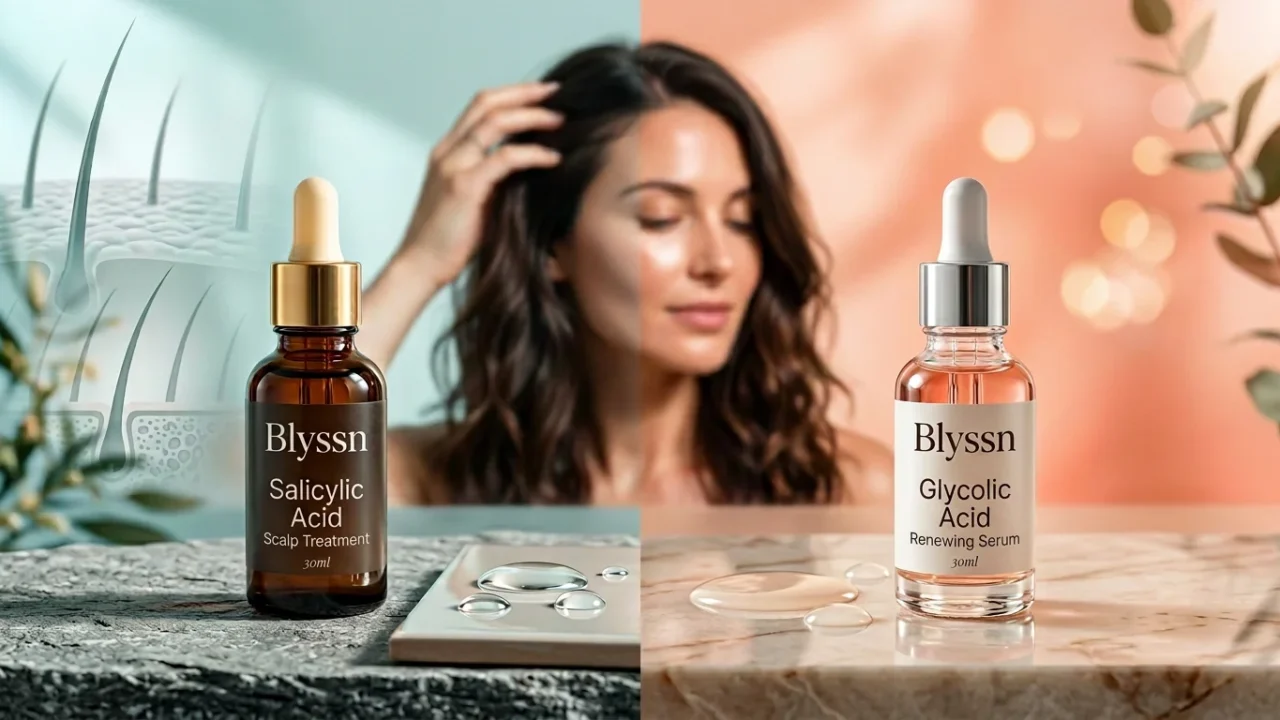
Salicylic acid (BHA) is superior for oily scalps and seborrheic dermatitis because it penetrates sebum buildup and fights yeast; glycolic acid (AHA) is better for dry, flaky, irritated scalps due to its hydrating properties. Choose salicylic for oil control and yeast issues, glycolic for dry scalp and itching.
Understanding Scalp Dandruff and Seborrheic Dermatitis
Dandruff is scalp hyperproliferation—the epidermis sheds skin cells faster than normal, creating visible flakes. But what causes this acceleration?
Primary Triggers:
- Malassezia overgrowth (yeast normally present on scalp, overgrows in certain conditions)
- Scalp sebum/oil (food source for yeast growth)
- Inflammatory response (scalp reacts to yeast overgrowth)
- Scalp pH imbalance (acidic environment encourages yeast)
- Dead skin accumulation (bacterial colonization follows)
Seborrheic dermatitis is the clinical diagnosis—a chronic inflammatory condition where the scalp produces excess oil and yeast thrives, causing flaking, redness, and itching.
Chemical exfoliants help by addressing the dead skin buildup and, in salicylic’s case, penetrating oil-rich areas to disrupt yeast growth.
According to a 2025 PMC-published clinical study examining topical salicylic acid treatment for moderate to severe seborrheic dermatitis: “Scalp seborrheic dermatitis is a chronic, recurrent inflammatory skin condition associated with scalp sebum secretion and dysbiosis. Treatment with salicylic acid-based preparations significantly reduced severity of dandruff, itching, erythema, and inflammation over 4–12 weeks.”
This guide is part of our comprehensive guide for Salicylic Acid vs Glycolic Acid:
Salicylic Acid vs Glycolic Acid for Hyperpigmentation
Salicylic Acid vs Glycolic Acid for Ingrown Hairs
Salicylic Acid: The Oil-Control and Yeast Fighter
Why Salicylic Excels for Scalp Issues:
Salicylic acid’s oil-soluble (lipophilic) nature means it penetrates sebum-rich scalp environments where water-soluble glycolic cannot reach. This allows salicylic to:
- Dissolve sebum buildup — Removes the food source yeast feeds on
- Penetrate follicles — Reaches oil glands and hair follicles where yeast colonies form
- Combat Malassezia — Research shows salicylic has antimicrobial activity against yeast
- Reduce inflammation — Anti-inflammatory properties calm scalp irritation
- Regulate pH — Salicylic’s slight acidity creates environment hostile to yeast overgrowth
Best For:
- Oily scalps with dandruff
- Seborrheic dermatitis (clinical diagnosis)
- Yeast-related scalp issues
- Heavy sebum production
- Dark, thick scalp buildup
- Those with acne-prone scalps
- Post-product buildup and residue
Application:
- Concentration: 1–2% in daily shampoos; 20–30% in professional scalp treatments
- Method: Pre-shampoo treatment or medicated shampoo
- Frequency: 2–3 times weekly for maintenance; daily for active treatment
- Best timing: Leave on scalp 10–15 minutes before shampooing for penetration
The Benefits:
- Penetrates oil-rich scalp — Reaches areas glycolic cannot
- Yeast-fighting properties — Antimicrobial action against Malassezia
- Sebum regulation — Decreases oil production (unique to salicylic)
- Immediate symptom relief — Itching and flaking reduce within 1–2 weeks
- Proven efficacy — Decades of clinical use for seborrheic dermatitis
- Scalp balance — Restores healthy pH and microbial balance
The Trade-Offs:
- Can be drying — Oil-soluble action may over-dry if overused
- Potential scalp irritation — Some experience temporary tightness or burning
- Not ideal for sensitive scalps — May irritate if scalp is already inflamed
- Less hydrating — Won’t help dry, itchy scalp (glycolic is better)
Glycolic Acid: The Hydrating Surface Exfoliant
Why Glycolic Excels for Dry, Irritated Scalps:
Glycolic acid’s water-soluble nature means it stays on the scalp surface, providing gentle exfoliation without the aggressive oil penetration of salicylic. This makes glycolic ideal for dry, irritated, or itchy scalps.
How It Works:
- Gentle surface exfoliation — Removes dead skin buildup without harsh penetration
- Hydration support — Water-soluble nature retains moisture
- Supports scalp healing — Creates environment for barrier repair
- pH balancing — Maintains scalp’s natural pH for healthy barrier
- Removes buildup — Clears product residue and mineral deposits
Best For:
- Dry, flaky, itchy scalps
- Sensitive scalps prone to irritation
- Scalps recovering from chemical or heat damage
- Product buildup and mineral buildup
- Those with psoriasis or eczema-prone scalps
- Irritated scalps from other treatments
- Overall scalp health and hydration
Application:
- Concentration: 5–10% in gentle formulas; 20–30% in professional peels
- Method: Pre-shampoo treatment or gentle scalp serum
- Frequency: 1–2 times weekly for maintenance; can be more frequent than salicylic
- Best timing: Leave 10–15 minutes on scalp before shampooing
The Benefits:
- Gentle, non-irritating — Hydrating action soothes irritation
- Safe for sensitive scalps — Much lower irritation potential than salicylic
- Supports barrier healing — Helps repair compromised scalp barrier
- pH maintenance — Keeps scalp’s natural pH balanced
- Long-term scalp health — Builds healthier scalp ecosystem
- No over-drying — Gentler for already-dry scalps
The Trade-Offs:
- Cannot penetrate oil buildup — Ineffective for sebum-heavy scalps
- Slower results for yeast — Won’t directly fight Malassezia as effectively as salicylic
- Less effective for active seborrheic dermatitis — Gentler nature means less aggressive treatment
- Better preventative than curative — Works best for maintaining health, not treating active issues
Head-to-Head Comparison: Scalp Needs Determine Choice
| Factor | Salicylic Acid | Glycolic Acid |
|---|---|---|
| Oil Penetration | Excellent | Surface only |
| Yeast Fighting | Strong antimicrobial | Minimal |
| Sebum Control | Superior | Minimal |
| Hydration Support | Minimal | Strong |
| Best For | Oily, seborrheic scalp | Dry, sensitive scalp |
| Irritation Risk | Moderate | Low |
| Active Dandruff | Superior treatment | Preventative only |
| Scalp Sensitivity | Avoid if inflamed | Safe for sensitive |
| Frequency | 2–3x weekly | 1–2x weekly (can be more) |
| Results Timeline | 1–2 weeks | 3–4 weeks |
Curated for You: Salicylic Acid vs Glycolic Acid for Hyperpigmentation
Clinical Evidence: What Research Shows
Salicylic Acid for Seborrheic Dermatitis:
A 2025 Journal of Cosmetic Dermatology study examined topical salicylic acid combined with piroctone olamine and zinc PCA in 20 patients with moderate to severe scalp seborrheic dermatitis. Results:
- Week 2–4: Significant reduction in dandruff severity, itching, and erythema
- Week 8–12: 85%+ improvement in scalp condition
- Week 16: Sustained improvement; maintenance treatment successful
Dermatologists concluded: “Salicylic acid-based scalp treatments demonstrate superior efficacy for seborrheic dermatitis due to the compound’s oil-soluble penetration and anti-yeast properties.”
Glycolic Acid for Scalp Health:
A separate 2024 study examined glycolic acid in scalp serums for dry, irritated scalps. Findings:
- Improved hydration: 20%+ increase in scalp moisture retention
- Reduced itching: 60%+ improvement in itchy scalp symptoms
- Maintained pH balance: Natural scalp acidity preserved
- No adverse effects: Safe even on very sensitive scalps
Choosing by Scalp Type and Condition
Oily Scalp with Visible Dandruff → Salicylic Acid
- Oil penetration is critical
- Yeast control is priority
- Fast results matter
- Start with 1–2% salicylic shampoo, 2–3 times weekly
- Combine with conditioner (salicylic can be drying to hair)
Dry, Flaky, Itchy Scalp → Glycolic Acid
- Gentle exfoliation needed
- Hydration is priority
- Barrier repair matters
- Use 5–8% glycolic pre-shampoo, 1–2 times weekly
- Pair with hydrating conditioner
Combination Scalp (Oily Roots, Dry Ends) → Start with Salicylic
- Address oil and yeast first with salicylic
- Once controlled, add glycolic for maintenance
- Apply salicylic to scalp/roots, glycolic to mid-length/ends if needed
Sensitive Scalp, Unclear Condition → Start with Glycolic
- Gentler entry point
- If itching/flaking persist after 4 weeks, add salicylic
- Reduce glycolic frequency if switching to salicylic
Expert Protocol: Best Scalp Treatment
The most effective approach combines both acids strategically:
Week 1–2: Salicylic Acid (Active Treatment)
- If oily/dandruff dominant: Use salicylic 2–3 times weekly
- Objective: Reduce yeast, control sebum, clear flakes
- Expected result: Dramatic improvement in visible flaking and itching
Week 3–4: Transition
- Reduce salicylic to 1 time weekly (maintenance)
- Introduce glycolic 1 time weekly (pH balance, ongoing health)
- Objective: Maintain improvements while supporting long-term scalp health
From Week 5+: Maintenance Routine
- Salicylic 1 time weekly (if scalp tends oily) OR discontinue if cleared
- Glycolic 1–2 times weekly (ongoing scalp health and barrier support)
- Alternate nights to avoid over-exfoliation
If Scalp Becomes Irritated:
- Pause all exfoliants
- Simplify to gentle sulfate-free shampoo and hydrating conditioner
- Resume with glycolic (gentler) after barrier recovers
Application Guide: How to Use Each Acid on Scalp
Salicylic Acid Scalp Treatment:
- Concentration: 1–2% for daily shampoos; 2–3% for treatment
- Method: Apply to DRY scalp 10–15 minutes before shampooing
- Technique: Part hair into sections; apply directly to scalp (not hair)
- Frequency: 2–3 times weekly for active treatment; 1 time weekly for maintenance
- Follow-up: Shampoo thoroughly; use deep conditioning on hair (salicylic can dry hair)
- Duration: 4–12 weeks for complete improvement
Glycolic Acid Scalp Treatment:
- Concentration: 5–10% pre-shampoo; 8–12% in leave-on serums
- Method: Apply to clean but damp scalp; massage gently
- Technique: Section hair; apply to scalp (not strands if possible)
- Frequency: 1–2 times weekly (can be more frequent than salicylic)
- Timing: Leave 10–15 minutes on scalp; shampoo with regular shampoo
- Duration: Ongoing maintenance; results improve over 8–12 weeks
Timeline: Expected Results
With Salicylic Acid (Oily, Dandruff Scalp):
- Week 1: Flaking reduced; itching decreases
- Week 2–3: Visible improvement; scalp feels less oily
- Week 4–6: Significant dandruff reduction; itching nearly resolved
- Week 8–12: Near-complete improvement; maintenance phase
- Month 4+: Sustained with weekly salicylic use
With Glycolic Acid (Dry, Itchy Scalp):
- Week 1–2: Scalp feels slightly better; itching minimal
- Week 3–4: Noticeable hydration improvement; flakes reduce
- Week 6–8: Visible improvement; scalp texture smoother
- Week 10–12: Significant sustained improvement
- Month 4+: Continued benefits; scalp health maintained
Critical Scalp Care Tips
Before Starting Acids:
- Identify your scalp type (oily, dry, or combination)
- Determine if issue is dandruff, seborrheic dermatitis, product buildup, or sensitivity
- Patch test on small scalp area first (exfoliants can sensitize scalp)
During Acid Use:
- Never apply acids to open wounds or severely inflamed scalp
- Keep acids away from eyes (scalp application can drip)
- Use sulfate-free shampoo (sulfates interfere with acid effectiveness)
- Deep condition hair afterward (protect hair shaft from drying acids)
- Don’t mix salicylic and glycolic on same day initially
Post-Treatment Maintenance:
- Continue preventive acid use even after condition clears
- Adjust frequency based on scalp response (less frequent in winter, more in summer typically)
- Combine with dandruff shampoo if condition persists (acids alone may need support)
- See dermatologist if severe seborrheic dermatitis (prescription-strength treatment may be needed)
Next Exfoliation Step: Salicylic Acid vs Glycolic Acid for Ingrown Hairs
SOUTH ASIAN AUDIENCE ADAPTATION
In South Asia, where hot, humid climates exacerbate scalp issues and dandruff prevalence is high, the salicylic vs glycolic choice is strategically important.
Salicylic acid has become the standard recommendation across Indian dermatology for seborrheic dermatitis and oily dandruff, with many professionals recommending 2–3% salicylic shampoo 2–3 times weekly as baseline treatment. The region’s humidity accelerates yeast growth on scalp, making salicylic’s antimicrobial properties particularly valuable.
However, South Asia’s diverse climate (dry winters in North India, persistent humidity in South/East) has also driven interest in glycolic acid for dry scalp conditions. Many South Asian beauty practices now incorporate salicylic-based scalp treatments as routine maintenance, recognizing that preventive scalp care reduces the flare-ups common in tropical humidity.
Ayurvedic practitioners are increasingly combining traditional oil treatments with modern salicylic acid protocols, bridging ancient scalp wisdom with contemporary dermatology—a uniquely South Asian approach to scalp health.
This guide is part of our complete guide on: Salicylic Acid vs Glycolic Acid: The Complete Acne & Texture Guide