
Quick Answer:
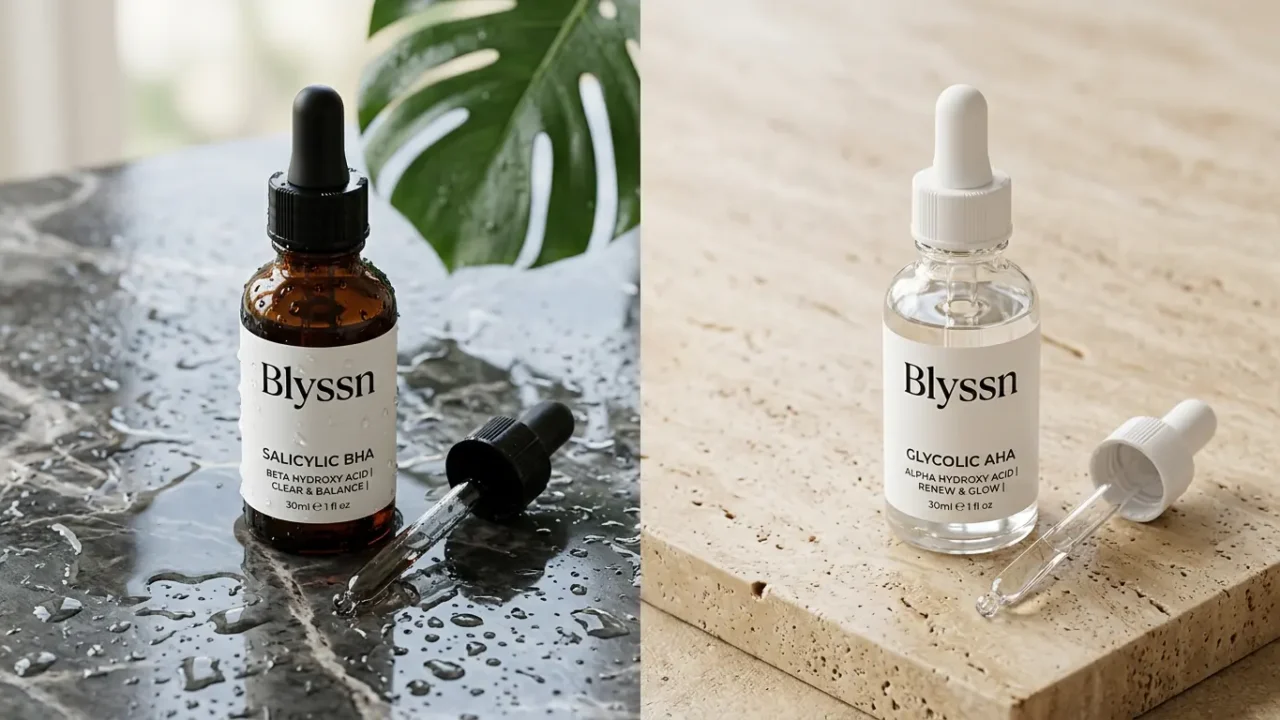
Salicylic acid (BHA) penetrates pores to clear oil and bacteria, making it the acne specialist; glycolic acid (AHA) exfoliates the surface for texture and brightening, making it the anti-aging powerhouse. Your choice depends on whether you prioritize pore clarity or skin tone.
Understanding the Two-Path Approach
Salicylic acid and glycolic acid solve different problems in different ways. While both are chemical exfoliants, their solubility creates completely different capabilities.
Glycolic acid is water-soluble, meaning it dissolves in water and works exclusively on the skin’s surface and upper epidermis. It excels at breaking down dead cell buildup and stimulating collagen.
Salicylic acid is oil-soluble (lipophilic), meaning it can travel through sebum and penetrate deep into pores. This oil-soluble nature gives salicylic acid a unique superpower: it can dissolve the oil and bacterial buildup causing acne from the inside out.
A 2025 comparative study published in the IP Indian Journal of Clinical and Experimental Dermatology directly compared 30% salicylic acid peel to 50% glycolic acid peel in patients with mild to moderate acne. Both were effective, but salicylic acid showed superior results for active breakouts and sebum control, while glycolic acid excelled at improving post-acne pigmentation and overall texture.
This guide is part of our complete exfoliation journey:
AHA vs BHA
Mandelic Acid vs Glycolic Acid
Glycolic Acid vs Lactic Acid
PHA vs AHA
Best Acid for Beginners
For more on the specific uses of Salicylic Acid vs Glycolic Acid, read:
Salicylic Acid vs Glycolic Acid for Hyperpigmentation
Salicylic Acid vs Glycolic Acid for Ingrown Hairs
Salicylic Acid vs Glycolic Acid for Scalp
Salicylic Acid: The Pore-Clearing Specialist
What It Is:
Salicylic acid is a beta hydroxy acid (BHA) found naturally in willow bark. It’s the most common BHA in skincare and the gold standard for acne-prone skin.
How It Works:
Because it’s oil-soluble, salicylic acid penetrates into sebaceous glands and hair follicles where oil and dead cells accumulate. Once inside pores, it dissolves the gunk (sebum, bacteria, dead skin cells) that causes blackheads, whiteheads, and inflammatory acne.
Best For:
- Oily or combination skin
- Active acne (blackheads, whiteheads, cystic breakouts)
- Clogged pores and congestion
- Excess sebum production
- Rosacea and keratosis pilaris (bumpy skin)
- Those who don’t respond to AHAs
The Benefits:
- Deep pore penetration — Reaches oil and bacteria AHAs cannot
- Sebum regulation — Decreases excess oil production (unique to BHAs)
- Acne prevention — Antimicrobial properties fight acne-causing bacteria
- Blackhead elimination — Oil solubility targets oxidized sebum specifically
- Proven track record — Decades of dermatological use and research
- Anti-inflammatory — Reduces redness and irritation from breakouts
The Trade-Offs:
- Can be drying — Oil-soluble action may strip moisture
- Less brightening power — Doesn’t address hyperpigmentation as effectively as glycolic
- Not ideal for aging concerns — Minimal collagen-stimulating properties
- Texture improvement — Works on pores but not overall surface texture
Glow with Intention: AHA vs BHA
Glycolic Acid: The Texture & Tone Master
What It Is:
Glycolic acid, derived from sugarcane, is an alpha hydroxy acid (AHA). The smallest AHA available, it penetrates rapidly and deeply into the skin.
How It Works:
Glycolic acid works on the skin’s surface and upper layers, dissolving the bonds holding dead skin cells together. This accelerates your skin’s natural cell turnover cycle, revealing fresher, smoother skin beneath.
Best For:
- Dull, textured, or rough skin
- Fine lines and anti-aging concerns
- Hyperpigmentation and post-acne marks
- Uneven skin tone
- Those seeking visible brightening
- Normal to dry skin types
The Benefits:
- Powerful texture improvement — Dramatic smoothing of rough, uneven skin
- Brightening and radiance — Tackles dullness and uneven tone
- Collagen stimulation — Drives anti-aging improvements
- Hyperpigmentation fading — Addresses age spots and post-acne marks
- Fast visible results — 2–3 weeks to noticeable change
- Refined pore appearance — While not penetrating pores like salicylic, consistent use refines their visible size
The Trade-Offs:
- Surface-only action — Cannot reach deep into oil-filled pores
- Not ideal for active acne — Won’t dissolve sebum or kill bacteria
- Higher irritation potential — More likely to cause stinging and redness
- Increased sun sensitivity — More photosensitivity than salicylic
One More Step Toward Healthy Skin: Glycolic Acid vs Lactic Acid
Head-to-Head Comparison
| Factor | Salicylic Acid | Glycolic Acid |
|---|---|---|
| Type | BHA (oil-soluble) | AHA (water-soluble) |
| Penetration | Into pores, deep | Surface to upper epidermis |
| Best For | Acne & oily skin | Texture & anti-aging |
| Pore Clearing | Excellent | Moderate |
| Sebum Regulation | Yes (decreases oil) | No |
| Brightening | Minimal | Excellent |
| Texture Smoothing | Surface only | Deep smoothing |
| Collagen Stimulation | Minimal | Strong |
| Irritation Potential | Moderate | Moderate to high |
| Dryness Risk | Higher | Moderate |
| Best Concentration | 0.5–2% | 5–10% |
Curated for You: Mandelic Acid vs Glycolic Acid
Choosing by Skin Concern
If Your Main Issue Is ACNE → Salicylic Acid
Salicylic acid is the proven choice for active breakouts, blackheads, and clogged pores. Its oil-soluble nature lets it penetrate into pores to dissolve sebum and kill bacteria—something glycolic simply cannot do.
- Start with 0.5–1% salicylic, 2–3 nights weekly
- Increase to 1–2% after 3–4 weeks if well-tolerated
- Use consistent SPF (salicylic doesn’t increase photosensitivity as much as glycolic)
If Your Main Issue Is TEXTURE & AGING → Glycolic Acid
Glycolic acid excels at refining rough, dull, uneven skin and triggering collagen rebuilding. It’s the better choice if fine lines, uneven tone, or post-acne marks are your priority.
- Start with 5–7% glycolic, 2–3 nights weekly
- Carefully increase to 7–10% after 4 weeks
- Mandatory broad-spectrum SPF daily (glycolic increases photosensitivity)
If You Have COMBINATION CONCERNS → Alternate or Combine
If you have acne breakouts AND uneven texture/tone, you have two approaches:
Strategy 1: Alternate
Salicylic 2–3 nights weekly (targeting breakouts), glycolic 2–3 nights weekly (targeting tone). Separate them to avoid over-exfoliation.
Strategy 2: Combination Product
Some formulas combine both acids in gentler concentrations (e.g., 0.5–1% salicylic + 5% glycolic). This allows simultaneous benefit but requires careful monitoring.
Start with Strategy 1 (alternating) unless you have professional guidance.
Complete Your Routine: PHA vs AHA
Clinical Evidence: What Research Shows
The 2025 comparative study found:
Salicylic Acid Superior For:
- Active acne lesion count reduction (64% improvement)
- Sebum regulation (measurable decrease in oil production)
- Blackhead clearance
- Prevention of new breakouts
Glycolic Acid Superior For:
- Post-acne pigmentation improvement (faster fading of marks)
- Skin texture refinement
- Overall brightness and radiance
- Fine line reduction
Both Equally Effective For:
- General skin smoothing
- Pore appearance refinement
Real-World Experience: User Testimonials
Salicylic Acid User (Acne-Prone):
“Finally something that actually stops my breakouts. Glycolic never touched my acne, but salicylic cleared my skin within 2 weeks. The oil control is incredible.” — Oily, acne-prone skin
Glycolic Acid User (Texture-Focused):
“My skin texture is so smooth now, and those post-acne marks have faded dramatically. But it didn’t help with my active breakouts at all—that’s where salicylic would come in.” — Normal to dry, post-acne focused
Combination User (Both Concerns):
“I alternate: salicylic Monday and Thursday to control breakouts, glycolic Wednesday and Saturday for brightness and texture. My skin is clearer and more radiant than ever.” — Combination skin
Step-by-Step Usage Guide
Salicylic Acid Routine:
- Cleanse with gentle, non-drying cleanser
- Pat skin dry (wait 5–10 minutes)
- Apply pea-sized amount of salicylic (0.5–2%)
- Wait 5–10 minutes before moisturizing
- Moisturize with hydrating formula
- Broad-spectrum SPF 30+ in morning
Glycolic Acid Routine:
- Cleanse thoroughly
- Allow skin to dry completely (crucial for glycolic)
- Apply pea-sized amount of glycolic (5–10%)
- Avoid touching face (may sting); wait 10 minutes
- Moisturize generously while skin is still slightly damp
- Mandatory broad-spectrum SPF 30+ (glycolic increases photosensitivity)
Read the Exfoliation Library: Best Acid for Beginners
SOUTH ASIAN AUDIENCE ADAPTATION
In South Asia, where acne prevalence is notably high due to humidity, pollution, and hormonal factors, the salicylic vs glycolic choice is highly practical.
Salicylic acid remains the preferred first-line acid for the region’s acne-prone population, with dermatologists across India and Pakistan recommending 1% salicylic routinely. However, the rise in hyperpigmentation and post-acne scarring concerns (more visible on darker skin) has prompted increasing interest in glycolic for post-breakout treatment.
Many South Asian skincare brands now offer both: salicylic for active management and glycolic for maintenance and post-acne recovery. The combination approach (alternating acids) has become increasingly popular in urban centers, allowing consumers to address both immediate acne control and long-term skin quality simultaneously. This dual strategy aligns with South Asian beauty priorities: first clear the skin, then refine texture and even tone.
This guide is part of our Complete Exfoliation Plan, read Chemical Exfoliation Guide for a comprehensive strategy covering your entire routine