
Quick Answer:
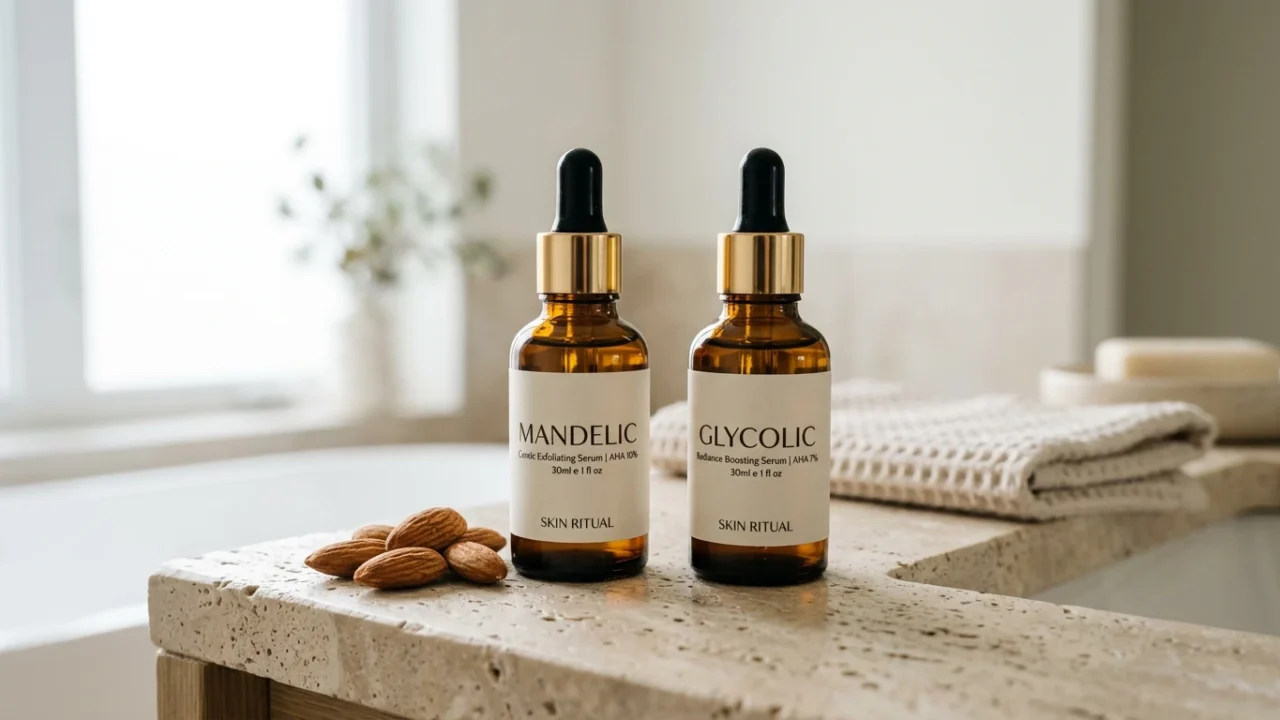
Mandelic acid penetrates skin slower due to its larger molecular size, making it the gentler choice for sensitive skin and darker skin tones; glycolic acid offers faster, more aggressive results for resilient skin. Choose mandelic if irritation is a concern, glycolic if you need visible transformation quickly.
The Molecular Science Behind the Difference
Mandelic acid and glycolic acid are both alpha hydroxy acids, but their molecular architecture creates drastically different skin experiences.
Glycolic acid, at approximately 76 Daltons, is the smallest AHA. Its tiny size allows it to zip through your skin’s surface rapidly, reaching the deeper epidermis within minutes.
Mandelic acid, derived from bitter almonds (the German word “Mandel” means almond), weighs approximately 152 Daltons—roughly twice the size of glycolic. This larger molecular weight translates into a fundamentally gentler penetration pattern: slower, more uniform absorption that minimizes the aggressive “rush” glycolic creates.
According to research cited by Phyto-C, “Mandelic acid penetrates skin more slowly and uniformly than glycolic or lactic acid. This slower absorption rate significantly reduces transient erythema (temporary redness) and the stinging sensation commonly associated with smaller AHAs. For individuals with reactive or sensitized skin, this difference is not trivial—it’s the difference between an exfoliant they can use consistently and one they abandon after two applications.”
This guide is part of our complete exfoliation journey:
AHA vs BHA
Glycolic Acid vs Lactic Acid
Salicylic Acid vs Glycolic Acid
PHA vs AHA
Best Acid for Beginners
Why Mandelic Acid Is Uniquely Gentle
Beyond just molecular size, mandelic acid has a unique chemical trait: it’s aromatic (meaning it has a ring-like molecular structure). This aromaticity makes mandelic acid slightly oil-soluble—a property shared with BHAs. This dual nature contributes to its multi-tasking abilities:
- Slower, more uniform penetration — No aggressive “flash” of irritation
- Mild purifying properties — Helps clear congestion without harsh action
- Reduced inflammation — Less likely to trigger redness or reactivity
- Safer for darker skin tones — Lower risk of post-inflammatory hyperpigmentation (PIH)
Dermatrix.life reports that a 2024 PMC-indexed study evaluated “the efficacy and safety of alpha-hydroxy acids in dermatological practice,” noting that mandelic acid’s favorable tolerability profile has made it a preferred AHA exfoliant in skincare protocols for individuals who cannot tolerate smaller, faster-penetrating acids.
Mandelic Acid: The Sensitive-Skin Solution
What It Is:
Mandelic acid is an aromatic alpha hydroxy acid derived from bitter almonds. Its larger molecular weight and aromatic structure create a unique gentle-but-effective profile.
How It Works:
Mandelic acid exfoliates by loosening desmosomes (the protein bonds holding dead skin cells together), but does so slowly and evenly across the skin surface. This gradual action prevents the irritation flare-ups common with faster-penetrating acids.
Best For:
- Sensitive, reactive, or easily irritated skin
- Darker skin tones at higher risk for post-inflammatory hyperpigmentation
- Rosacea or eczema-prone skin
- Anyone who’s had bad reactions to glycolic acid
- Acne-prone skin that needs exfoliation without inflammation
- Beginner acid users
The Benefits:
- Remarkably gentle — Significantly fewer side effects than glycolic
- Anti-inflammatory — Reduces redness and soothing properties
- Acne-clearing without harshness — Mild purifying action unclogs pores
- Post-acne mark fading — Helps with hyperpigmentation through gentle exfoliation
- Safe for darker skin tones — Low post-inflammatory hyperpigmentation risk
- Sustainable use — Tolerability means you’ll stick with it consistently
The Trade-Offs:
- Slower results — Takes 8–12 weeks to see significant transformation
- Less aggressive anti-aging — Won’t stimulate collagen as powerfully as glycolic
- Not ideal for deep concerns — Surface-level action may not address severe scarring
Glow with Intention: AHA vs BHA
Glycolic Acid: The Powerful Performer
What It Is:
Glycolic acid, derived from sugarcane, is the smallest and fastest-acting AHA. It’s been the gold standard in professional peels and at-home skincare for decades.
How It Works:
Rapid penetration through all layers of the epidermis triggers visible cell turnover quickly. Glycolic’s power is undeniable—but that power comes with a higher irritation cost.
Best For:
- Oily or resilient skin
- Those seeking visible anti-aging results within weeks
- Acne-prone skin with a strong tolerance
- Active hyperpigmentation that needs aggressive treatment
- Experienced exfoliant users
The Benefits:
- Fastest visible results — 2–3 weeks to noticeable improvement
- Powerful collagen stimulation — Superior anti-aging action
- Deep resurfacing — Tackles texture at a cellular level
- High-impact brightening — Rapidly improves dull complexion
- Professional-grade strength — What dermatologists use in peels
The Trade-Offs:
- Higher irritation potential — Stinging, redness, burning common
- Not ideal for sensitive skin — Can trigger hypersensitivity
- Post-inflammatory hyperpigmentation risk — Especially on darker skin
- Moisture barrier disruption — May cause dryness or flaking
One More Step Toward Healthy Skin: Glycolic Acid vs Lactic Acid
Direct Comparison: Mandelic vs Glycolic
| Factor | Mandelic Acid | Glycolic Acid |
|---|---|---|
| Molecular Size | Large (~152 Da) | Small (~76 Da) |
| Penetration Speed | Slow & uniform | Fast & deep |
| Irritation Potential | Very low | Moderate to high |
| Results Timeline | 8–12 weeks | 2–4 weeks |
| Collagen Stimulation | Moderate | Strong |
| PIH Risk on Dark Skin | Minimal | Moderate to high |
| Best for Beginners | Excellent | Not recommended |
| Anti-Aging Power | Gentle | Aggressive |
| Sustainability | High (easier to stick with) | Medium (irritation may derail use) |
The Next Exfoliation Step: Salicylic Acid vs Glycolic Acid
Mandelic Acid vs Glycolic: Which Should You Choose?
Choose Mandelic Acid If:
- Your skin is sensitive, reactive, or easily irritated
- You’re new to chemical exfoliants
- You have rosacea, eczema, or post-procedure inflammation
- Your skin tone is darker (lower PIH risk is critical)
- Consistency matters more than speed
- You want multi-benefit exfoliation without the burn
- You’ve had bad reactions to glycolic before
Choose Glycolic Acid If:
- You have oily, resilient skin with a strong barrier
- Fine lines and anti-aging are your priority
- You want visible transformation within 3–4 weeks
- You’re experienced with exfoliants
- Your skin tolerates actives well
- You’re willing to accept temporary irritation for faster results
Complete Your Routine: PHA vs AHA
Real-World Experience: What Users Report
Mandelic Acid Users:
“Finally an acid that doesn’t make my face feel like it’s on fire. Results are slower but I actually stick with it. My post-acne marks have faded significantly over 3 months without any irritation.” — Sensitive skin user, melanin-rich
Glycolic Acid Users:
“Dramatic results but the first week was rough—stinging, peeling, redness. Worth it for the rapid improvement, but I couldn’t have handled this as a beginner.” — Oily, acne-prone skin user
Concentration and Frequency Guide
Mandelic Acid:
- Beginner: 5–8% daily or every other day
- Intermediate: 8–10% daily
- Can tolerate higher frequency due to gentleness
Glycolic Acid:
- Beginner: 5–7% only 2–3 nights weekly
- Intermediate: 7–10%, 3–4 nights weekly
- Advanced: 10%+, alternate nights to daily
- Requires longer adjustment period
The key: mandelic’s gentleness means you can start higher and use more frequently without barrier damage.
Can You Use Mandelic and Glycolic Together?
Yes—strategically.
Approach 1: Sequential Introduction Start with mandelic for 4–6 weeks to build exfoliation tolerance, then cautiously introduce glycolic on alternate nights.
Approach 2: Layered Strength Some brands combine both (e.g., Paula’s Choice 6% Mandelic + 2% Lactic for ultra-gentleness). This hybrid approach balances results with tolerability.
Approach 3: Targeted Use Mandelic on sensitive zones (around eyes, cheeks), glycolic on oilier areas (T-zone) if you have combination skin.
Never use both heavily on the same night when starting exfoliation.
Read the Exfoliation Library: Best Acid for Beginners
SOUTH ASIAN AUDIENCE ADAPTATION
For South Asian consumers, mandelic acid represents a major breakthrough in accessible exfoliation. Traditional concerns about skin sensitivity and post-acne hyperpigmentation (extremely common on darker complexions) make mandelic’s gentle profile particularly valuable.
Many dermatologists across India, Pakistan, and Bangladesh now recommend mandelic as the first exfoliant for anyone with sensitivity or darker skin—a significant shift from earlier glycolic-dominant practices. The ingredient aligns with cultural preferences for gentler skincare approaches while delivering visible results.
Additionally, mandelic acid’s anti-inflammatory and mild purifying properties make it ideal for tropical climates where heat and humidity exacerbate sensitivity and acne. South Asian beauty brands have begun featuring mandelic acid prominently, recognizing that effective skincare for the region requires gentleness alongside efficacy.
This guide is part of our Complete Exfoliation Plan, read Chemical Exfoliation Guide for a comprehensive strategy covering your entire routine